
— SIRIUS Solutions for
Impurity, E&L and contaminant screening
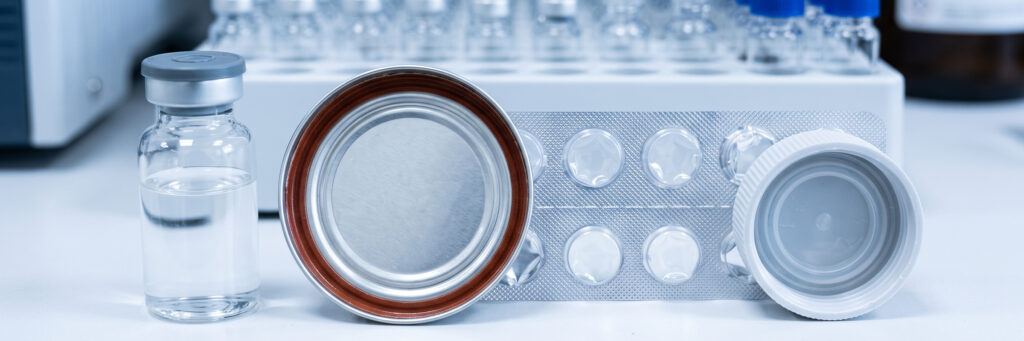
SIRIUS helps analytical, quality and exposure scientists screen packaging for extractables and leachables, profile impurities and degradation products of pharmaceuticals and agrochemicals, detect PFAS, and follow contaminants into the human body. Molecular formulas, structures and compound classes are annotated directly from LC-MS/MS data, so an unexplained peak becomes a structural hypothesis you can confirm.
Why impurity and E&L teams use SIRIUS
E&L libraries and suspect lists only cover what someone has already catalogued. Non-intentionally added substances, reaction products between packaging and product, and manufacturing by-products rarely have a reference spectrum, and exact mass alone cannot tell isomers apart.
SIRIUS works from the fragmentation spectrum itself. It proposes molecular formulas from isotope and fragmentation patterns, predicts a molecular fingerprint, and searches it against PubChem, your in-house databases or candidate structures you generate yourself. When nothing fits, it predicts the compound class or builds structures de novo.
Profile
Build impurity profiles of active substances and finished products, including precursors, by-products and isomers that have no CAS number yet.
Screen
Screen extracts and leachate samples for known additives and unexpected substances in one non-targeted run.
Trace
Follow degradation products, by-products and conjugated metabolites back to their parent compound, process or exposure source.
Most of what migrates, degrades or leaches was never in a database
A drug product, a packaging extract or a pesticide formulation is chemically crowded: the active ingredient sits next to synthesis by-products, degradants, additives, oligomers and reaction products between product and packaging. Targeted methods only find what is already on the list, and everything else stays invisible until it turns up in a quality investigation.
SIRIUS analyzes LC-MS/MS data and proposes molecular formulas, structures and compound classes from the fragmentation pattern itself. It can annotate an impurity or leachable that has no entry in any spectral library or structure database, and is just as useful for confirming a known additive as for characterizing a compound nobody has described.
Molecular formula annotation from isotope pattern and fragmentation tree, without needing a matching entry in any spectral library.
Molecular structure annotation predicts a molecular fingerprint and searches against public and your own custom databases.
Compound class prediction narrows down a chemical hypothesis, such as a phthalate ester or a paraben, before a structure is confirmed.
De novo structure generation proposes structures for compounds that exist in no database at all.
Food contact materials and E&Ls
Plastics, glass, can linings, closures and sealants all release chemical migrants into the products they hold: additives, oligomers, and their breakdown and reaction products. Targeted E&L libraries catch the usual suspects, but non-intentionally added substances (NIAS) call for non-targeted analysis. Matching exact mass and isotope pattern against a suspect list flags candidates, yet cannot separate compounds with the same molecular formula. The fragmentation spectrum can, and SIRIUS combines library matching with structure annotation in one workflow.
Molecular structure annotation predicts a molecular fingerprint and searches against public and your own custom databases.
Custom structure databases turn your suspect lists and additive inventories into a searchable candidate space.
Compound class prediction assigns unknowns to classes such as phthalate esters or parabens without any database.
Spectral library matching against your in-house E&L libraries and curated public spectra.
Field example
Researchers screened 37 liquor samples in plastic and glass packaging. SIRIUS provided correct formulas for key plasticizers and bisphenols and distinguished ethylvanillin from ethylparaben, two compounds with the same formula that mass-based suspect screening could not separate. Some of the highest phthalate levels were found in glass-packaged products.
More SIRIUS discoveries
114 chemicals migrating from food packaging identified, including hazardous plasticizers and persistent non-intentionally added substances.
Pharmaceutical impurities and degradants
During synthesis, formulation and storage, an active pharmaceutical ingredient can co-exist with synthesis-related impurities or degrade through hydrolysis, oxidation or photolysis. Forced degradation and stability studies produce many closely related structures, and almost none of them have a reference spectrum. SIRIUS lets you build your own search space: generate candidate degradants with custom reactions or BioTransformer, search them with the predicted fingerprint, and check each hit against the spectrum.
Transformation product prediction to automatically generate bio-transformation products, as well as custom chemical reactions.
Structure Sketcher lets you modify a candidate and instantly re-score it against the predicted fingerprint.
Substructure validation with analog hits shows whether the shared core with a known compound explains the spectrum.
Application note
Starting from a list of 816 approved drugs, we generated a BioTransformer database of more than 480,000 candidate structures and screened 92 river water samples. SIRIUS detected 292 transformation products, only 33 of which were found by spectral library search; 56 of the 85 high-confidence annotations were absent from spectral libraries.

More SIRIUS discoveries
Drug metabolites and drugrelated impurities in human plasma identified without reference standards and a priori knowledge of first- and second-pass drug metabolism.
PFAS and persistent contaminants
Per- and polyfluoroalkyl substances occur in water, consumer goods and industrial products as thousands of structures, most of them absent from any library. Their extreme mass defects and high fluorine content fall outside standard formula filters, and they tend to appear as homologous series that share a backbone but differ by a repeating unit. SIRIUS detects these signatures during pre-processing and makes whole families visible, so a single identified member can lead you to the rest of the series and back to its source.
PFAS detection strategy predicts fluorine and expands the formula search space to high-fluorine candidates.
Search and filter by PFAS tags, confidence ranges and executed annotation methods.
Homologous Series view groups related molecules in a Kendrick mass defect plot with a repeating unit of your choice.
Expansive search falls back to PubChem when your databases have no good candidate.
Field example: persistent offshore discharges
Researchers combined 60-day biodegradation tests with LC-HRMS to assess produced water from North Sea oil platforms. 32 to 44% of the polar chemicals persisted through the tests. SIRIUS characterized 145 persistent features, pointing to N-substituted aromatic rings as a major concern.

Field example: fluoropolymer production
Researchers monitored air downwind of a fluoropolymer plant. Suspect screening with SIRIUS revealed a homologous series of at least seven hydrogen-substituted perfluoroalkyl carboxylic acids, suspected PTFE polymerization by-products; three were confirmed with authentic standards.

More SIRIUS discoveries
Previously undetected chemicals with potential estrogenic activity in drinking water from regions with high breast cancer incidence.
Weathered tire wear particles and crumb rubber yielded 572 prioritized transformation products, including novel oligomers of the antioxidant TMQ and 45 transformation products never reported before.
Agrochemical and synthesis impurities
Technical-grade active ingredients and formulations carry manufacturing impurities from precursors, side reactions and storage, and they break down into derivatives that can be more hazardous than the parent. These impurities usually share a scaffold with the main compound, and many have never been described. SIRIUS ranks formula candidates per compound and refines them using the similarities between all compounds in your dataset. Because molecular structure annotation is not tied to a fixed database, you can search PubChem, your own inventories or structures you generated from the parent compound.
Network-enhanced formula annotation uses related compounds in the same sample set.
Field example
Researchers used SIRIUS network-enhanced formula annotation and molecular structure annotation in an impurity profiling protocol. They elucidated 18 structurally related impurities and grouped them by substitution pattern; 14 of them were reported for the first time.

More SIRIUS discoveries
A 6-year groundwater study traced legacy pesticides such as simazine, along with flame retardants and insect repellents, and showed that extreme weather can remobilize them down to 90 m.
Exposure biomonitoring
Contaminants from packaging, consumer products and the environment end up in human biofluids, often not as the parent compound but as metabolites and conjugates such as sulfated parabens or mercapturic acids. Targeted panels only measure what is already on the list. SIRIUS annotates what is actually there across entire cohorts, and lets you search dedicated libraries of predicted conjugates to link a signal in blood, urine or milk back to its exposure source.
Field example
Researchers screened human milk from Canada and South Africa with SIRIUS supporting structure elucidation. They found parabens and their sulfated forms, phthalate metabolites, PFAS and the rubber accelerator 1,3-diphenylguanidine, and reported phenyl paraben and 2-ethylhexyl 4-hydroxybenzoate in human milk for the first time.

More SIRIUS discoveries
Potentially allergenic transformation products of tattoo pigments identified in new online-LC-EC-MS approach.
Urine of women with ovarian malignancies showed significantly higher levels of six exposure biomarkers: two phthalates, two pesticides, a UV filter and an industrial by-product.
Annotations you can defend in an investigation report
An unknown impurity or leachable goes into a toxicological assessment or a quality investigation, so you need to know how far to trust each annotation. SIRIUS attaches explicit, exportable evidence to every step and makes it clear which candidates are worth confirming with an authentic standard.
Confidence score
rates how likely a structure hit is exactly correct, or highly similar to the true structure.
Substructure annotation
links fragment peaks and neutral losses to parts of a candidate, so it can be checked peak by peak and exported as a figure.
Identity and analog library matches
cross-check results against reference spectra and verify shared structural cores of related compounds.
Protection against suspect blindness
shows the best library match and the best structure hit side by side.
Feature and spectral quality metrics
flag weak or ambiguous features before they reach a report.
Exportable scores
travel with every result into summary tables for documentation and review.
From extraction study to report, at production scale
E&L programs, stability studies and batch release testing generate large, recurring datasets. SIRIUS processes them reproducibly and hands results back to the software and systems your lab already relies on.
Parameter-free LC-MS pre-processing
Feature detection, alignment and adduct detection with quality metrics for fast prioritization.
GUI, CLI and REST API
One project database behind all three: automate runs via CLI or API, then inspect them in the GUI.
Software integrations
Integrations with MassHunter, mzmine and Compound Discoverer keep SIRIUS inside existing workflows.
Computation presets
Save validated configurations and reuse them for every recurring study type.
Structured exports
Summary tables with scores, ChemVista-ready files and publication-quality SVG figures.
Searching hundreds of thousands of candidates, automatically
Non-targeted screening pays off when the candidate space is large and the annotation runs without manual work. SIRIUS searches custom databases with hundreds of thousands of structures across a full study, and keeps every result in one project the whole team can inspect.
SIRIUS has been applied across many impurity, E&L and contaminant studies
Over 4,000 compounds annotated and hidden toxic contaminants and bioactives semi-quantified in bee pollen supplements.
33 emerging contaminants, including antioxidants and industrial surfactants, found in tap water from 12 countries; 25 for the first time.
Plastic leachates, UV filters and wastewater-derived inputs uncovered inside a protected Ramsar wetland.
Previously overlooked toxic drivers in air, including 2-indanone and 2-vinylpyridine, linked to lung cell toxicity.
A MS2-based priority score built on SIRIUS fingerprints, MS2Tox and MS2Quant cut wastewater non-target datasets by 81 to 99% before identification.
See what SIRIUS finds in your data
Bring an extractables study, a stability sample or a batch with a peak nobody can explain. We will show you what SIRIUS annotates from your own fragmentation data, and how much confidence stands behind each result.

Related solutions
Pharmaceuticals and Drug Discovery
Drug leads, metabolites and degradants
Dietary compounds, residues and contaminants
Environmental and water analysis
Unknown pollutants and their transformation products
Known and novel PFAS in environmental and consumer samples
Explore more on the blog
Browse related discoveries and application notes by topic.
For Research Use Only. Not for use in diagnostic procedures.