As we prepare for longer human missions beyond Earth, understanding the invisible ecosystems of space habitats has become critical for astronaut health. The International Space Station (ISS) is not just a home and laboratory—it is also a closed microbial and chemical environment unlike anything on Earth. This study mapped the ISS microbiome and metabolome in unprecedented detail, uncovering its vast chemical “dark matter” using SIRIUS.
News
Screening Massive Small Molecule Libraries for Early Drug Discovery
Our recent study co-authored by researchers at Bright Giant, FSU Jena, Leiden University and Oncode Institute introduces a major leap forward in affinity selection screening for early drug discovery: Self-Encoded Libraries. Our approach uses advanced mass spectrometry to screen hundreds of thousands of small molecules in a single experiment, bypassing the significant limitations of traditional high-throughput screening as well as affinity selection with barcoded libraries. It allows drug discovery teams to identify high-affinity drug candidates faster, more affordably, and against targets previously inaccessible to common screening methods.
Help us improve SIRIUS!
We’ve launched a quick user survey to hear directly from you about how you’re using SIRIUS, its impact on your work, and the challenges you’d love to see solved.
Your insights will influence upcoming features and improvements.
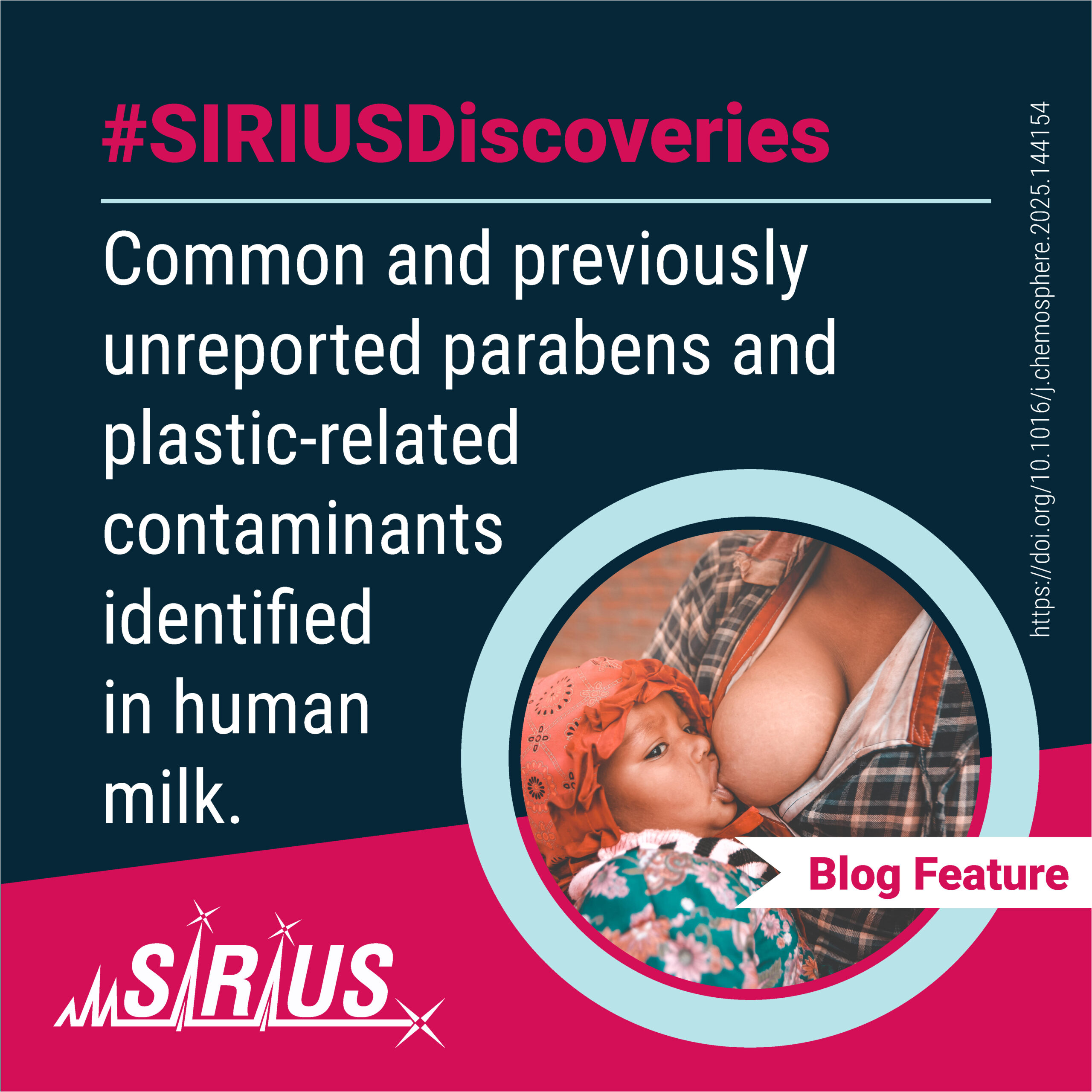
Uncovering Hidden Contaminants in Human Milk
Human milk is the ideal source of nutrition for infants, but growing concerns exist about the presence of chemical contaminants that can find their way into it. For years, scientists have relied on targeted analysis, a method that can only find what they are already looking for. In this non-targeted approach utilizing SIRIUS, researcher successfully identify common and previously unreported chemical contaminants and gain a more comprehensive understanding of the chemical exposures mothers and infants face.
Leading suite for structure annotation
🥇 SIRIUS has emerged as the leading suite for molecular structure annotation from MS/MS data
A recent review on mass spectrometry-based metabolomics for natural product research positions SIRIUS as the leading suite for molecular structure annotation, because of its comprehensive and modular design, its proven ability to handle large-scale analyses, and its integration of multiple powerful subtools that address various aspects of annotation.
A. Rutz et al. Nat. Prod. Rep. (2026) doi: 10.1039/D5NP00034C
How To | Structure Sketcher
Do you ever look at the best hit from a structure database search and instantly know how to improve it?
In SIRIUS, your chemical intuition just got a powerful new tool: the Structure Sketcher. This new tool empowers you to manually refine and modify candidate structures, turning initial hypotheses into high-confidence annotations. It’s the perfect way to apply your expertise and improve your results.
Learn how to use the Structure Sketcher in our new tutorial.
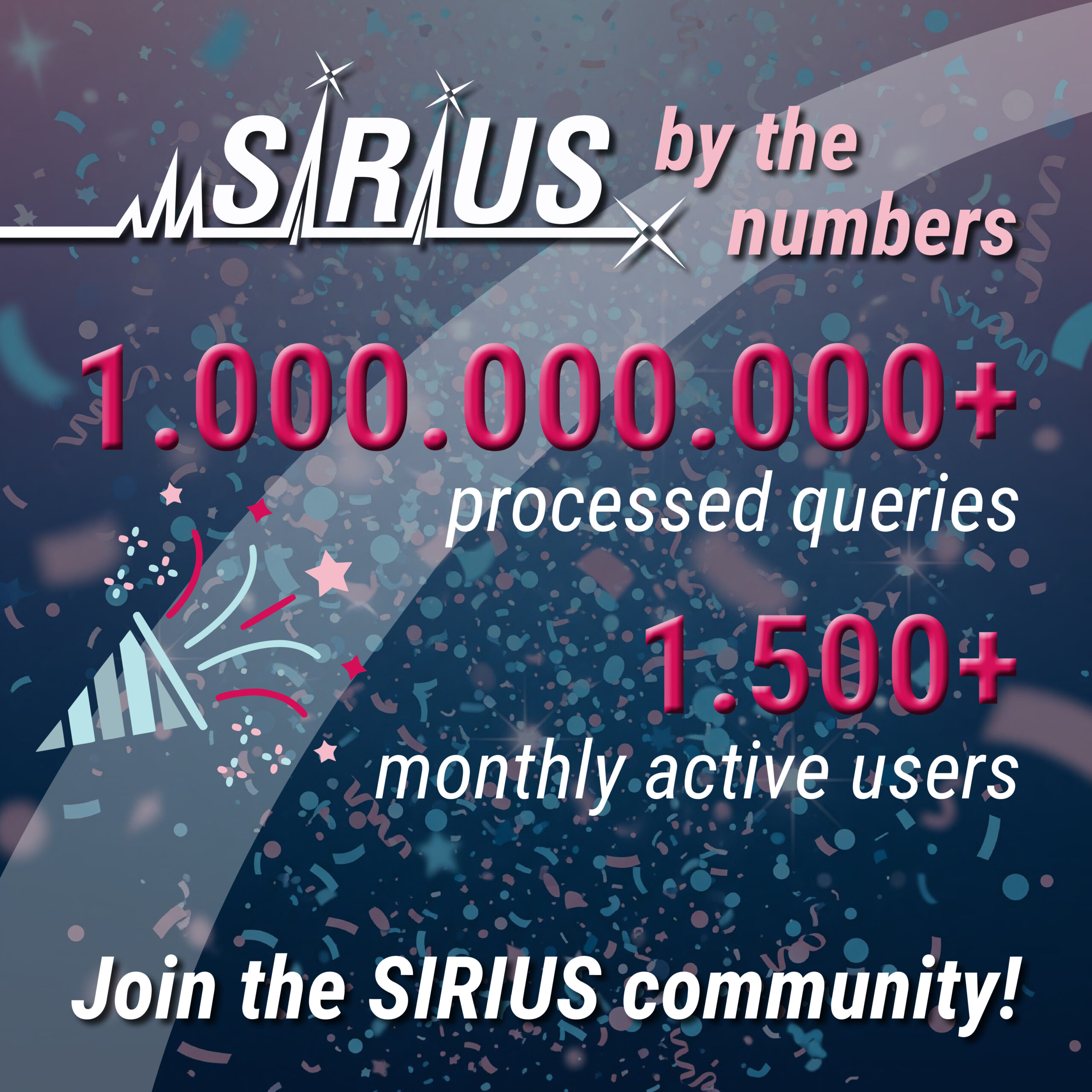
1 billion processed queries
We’re blown away by the growth of the SIRIUS community! The demand for accurate small molecule identification is accelerating, and we’re seeing unprecedented usage and impact of our software across the globe. Thank you for being part of this journey.
SIRIUS 5 | End of life
Important Announcement for SIRIUS 5 Users: Please be aware that maintenance and support for SIRIUS 5 will officially end on February 28, 2026.
To ensure you continue to benefit from the latest advancements in small molecule identification from mass spectrometry data, we highly recommend upgrading to SIRIUS 6.
Retention Time Prediction
The Böcker Lab has introduced a groundbreaking two-step method that changes the game of retention time prediction. Instead of predicting retention times directly, the method predicts a Retention Order Index (ROI)—a simple ranking that reflects the order in which compounds elute. This ROI can then be mapped to retention times with ease.
SIRIUS 6.3 is here
We’re excited to introduce the latest version of SIRIUS with powerful new features (v6.2/6.3) to enhance small molecule identification:
✨ Biotransformer 3.0 integration: Bio-transformations can now be automatically created during the custom database import process.
✨ Substructure validation by spectral library analog search: By highlighting shared substructure explanations and neutral losses observed in analogs you can verify if the shared structural core of a spectral library analog explains the observed data.
✨ Structure Sketcher: Manually modify existing database candidate structures and instantly re-score them against the predicted molecular fingerprint.
✨ Kendrick Mass Defect plots for homologous series: Rapidly visualize, group, and annotate structurally related molecules that share a common scaffold but differ by repeating units without requiring prior library matches.
✨ Software tour guides: This guided onboarding system uses contextual overlays, tooltips, and step-by-step walkthroughs to familiarize you with the software.
✨ Improved result views: The LC-MS View and the Library Matches View have been redesigned.
Explore the new features and elevate your mass spectrometry data analysis.
Workshop Recap
Automated Annotation with SIRIUS 6
We had an incredible turnout, with over 80 interested (future) SIRIUS users filling the room.
We demonstrated how SIRIUS 6 is transforming small molecule annotation by going beyond traditional spectral libraries. By combining structural database searching and molecular structure generation, SIRIUS 6 offers a powerful, integrated approach to annotation. We also highlighted the seamless integration of spectral libraries for robust validation through analog searching.
It was inspiring to see such strong interest in advanced metabolomics tools. We wrapped up with a vibrant 20-minute Q&A.
Thanks to everyone who joined and engaged so actively!
Talk at Metabolomics 2025
Novel transformation product annotation with SIRIUS
In this talk, we’ll introduce a new, transparent and interpretable workflow built into SIRIUS that combines structure generation with BioTransformer, annotation via CSI:FingerID, high-speed spectral & analog search with a novel linear-time cosine similarity algorithm and combinatorial fragmentation to annotate substructures & MS/MS peaks.