News

How can AI accelerate plant drug discovery?

Is it time for a paradigm shift to solve the pharmaceutical “supply crisis” caused by the industrial instability of plant cell cultures?

Decoupling drug discovery from manufacturing.
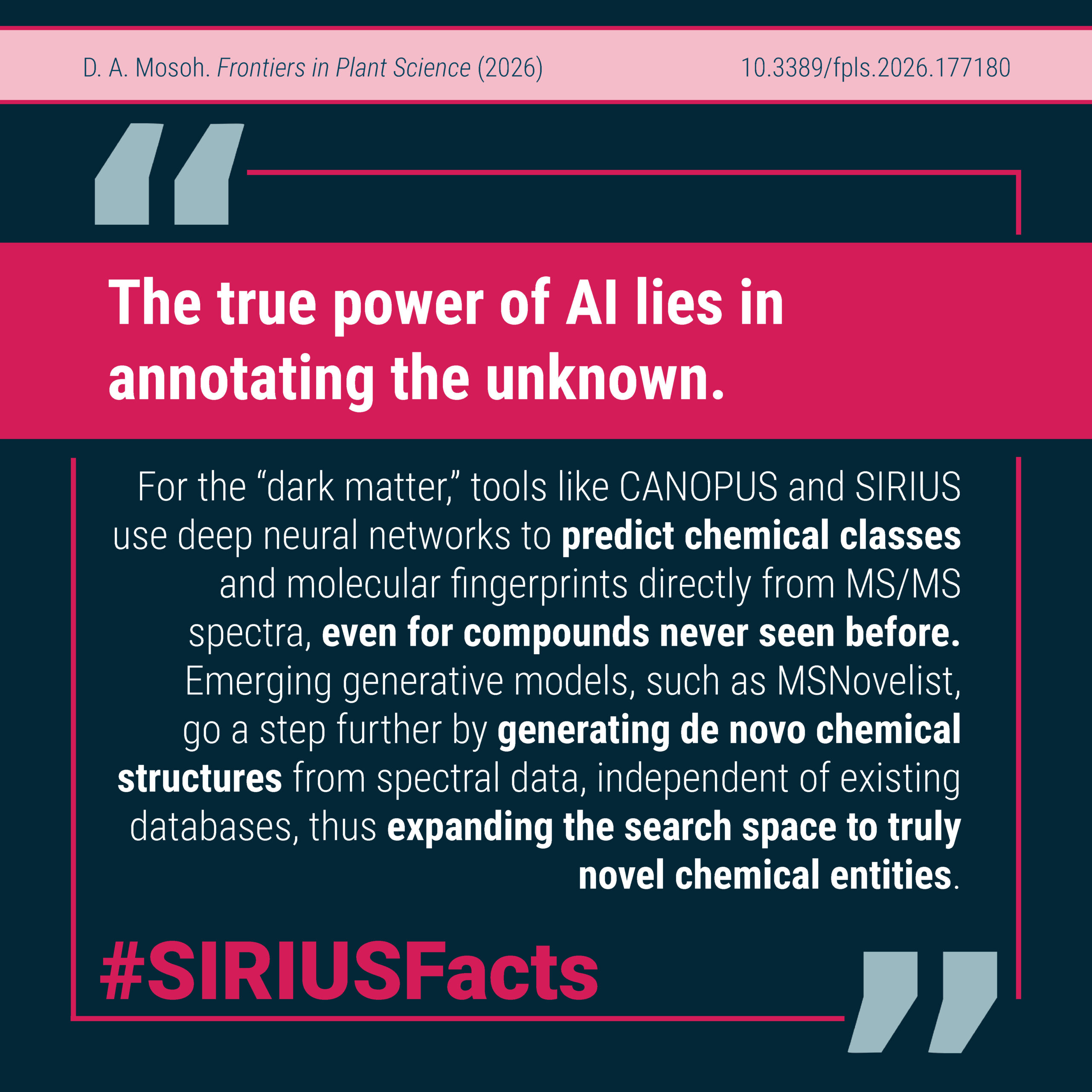
Instead of using plants for production, researchers should harness the “productive chaos” of plant stress responses solely to discover new therapeutic compounds. Once discovered, these complex biosynthetic pathways can be transferred to stable microbial hosts or engineered cell factories for reliable, large-scale manufacturing.

Artificial intelligence and machine learning serve as the core engine for this shift by streamlining plant metabolic data into predictive pipelines. AI tools like SIRIUS quickly decode unknown molecular “dark matter,” allowing researchers to annotate, prioritize, and scale novel bioactive candidates far faster than traditional timelines allow.

D A Mosoh et al. Front. Plant Sci. (2026) doi: 10.3389/fpls.2026.1771802

Spectral denoising affecting compound identification

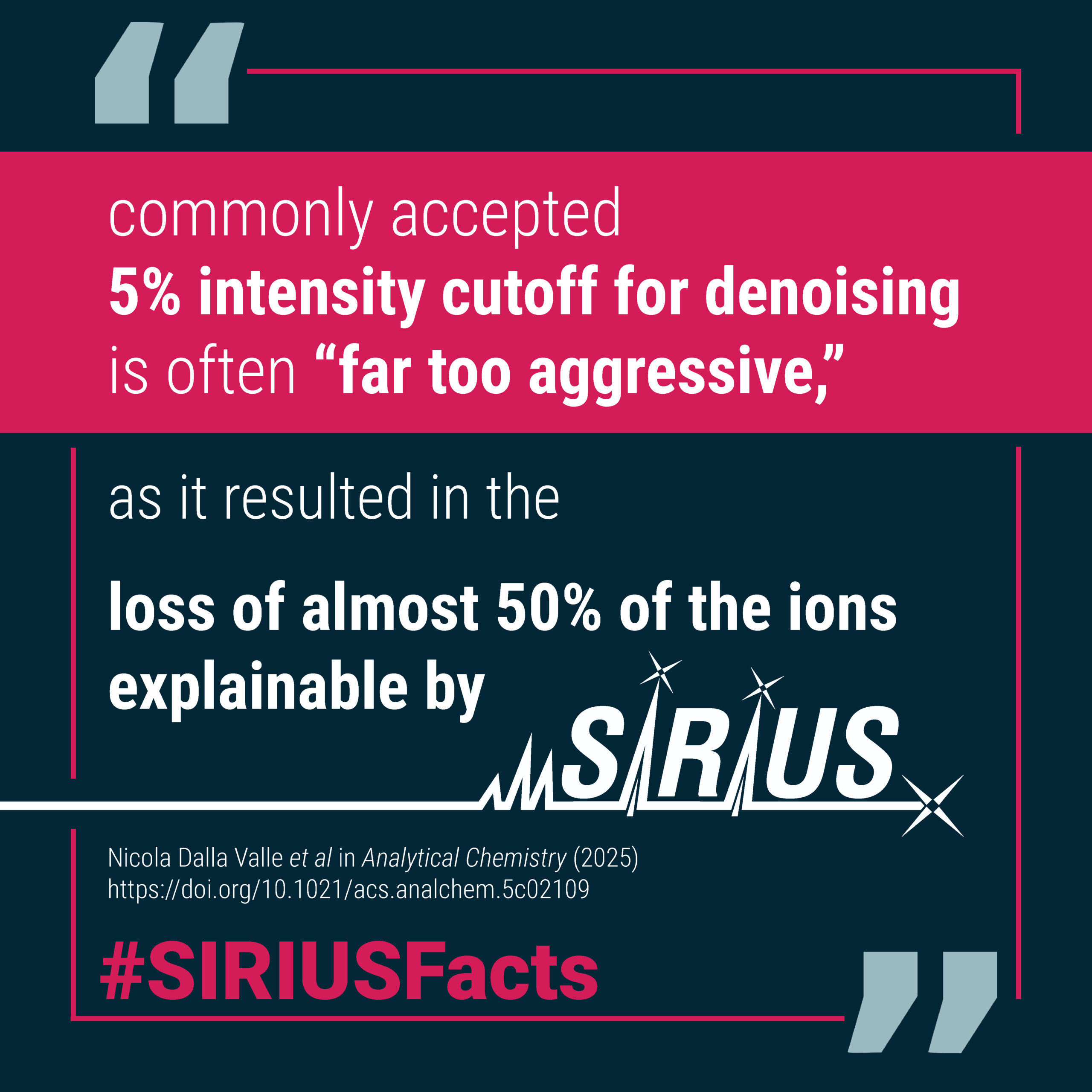
A critical look at how spectral denoising affects compound identification and molecular network reliability.
A study found that applying a standard 5% intensity cutoff was often too aggressive, resulting in the loss of nearly 50% of the ions explained by SIRIUS.

N. Dalla Valle et al. Anal. Chem. (2025) doi: 10.1021/acs.analchem.5c02109

SIRIUS for prioritization in non-target screening

SIRIUS plays a significant role in prioritization strategies for non-target screening in environmental samples. Its primary function is to generate molecular fingerprints from MS/MS data, which are then used for compound identification or toxicity prediction.

A. Torres-Agullo et al. J. Chromatogr. A (2025) doi: 10.1016/j.chroma.2025.465944

Molecular fingerprints for toxicity prediction

Although direct structural information may not always be available, specific structural details, such as the presence of function groups, can be obtained from MS/MS spectra using SIRIUS. These molecular fingerprints serve as crucial inputs for other predictive models, such as toxicity predictions, even when the exact identity of a compound is unknown.

A. Canchola et al. Environ. Int. (2025) doi: 10.1016/j.envint.2025.109404

Making small molecule annotation more accessible

mzio and Bright Giant have partnered to seamlessly connect mzmine with SIRIUS. Today we are thrilled to present this one-click, automated integration to deliver a rapid and convenient non-targeted analysis experience.

Read the full press release.

SIRIUS In the Pipeline

We are absolutely honored and excited that our newest publication on our tag-free screening platform has been highlighted by Derek Lowe on his Science Magazine blog, “In the Pipeline”, about drug discovery and the pharma industry.

E. van der Nol et al. Nat. Commun. (2025) doi: 10.1038/s41467-025-65282-1

MassHunter goes SIRIUS

The newest Agilent Technologies MassHunter Explorer 2.0 release integrates direct access to advanced unknown compound elucidation with SIRIUS.

Now, you can send statistically significant features directly to SIRIUS for advanced molecular formula annotation, structure prediction, and compound classification.

Help us improve SIRIUS!

We’ve launched a quick user survey to hear directly from you about how you’re using SIRIUS, its impact on your work, and the challenges you’d love to see solved.
Your insights will influence upcoming features and improvements.

Start survey.

Leading suite for structure annotation

🥇 SIRIUS has emerged as the leading suite for molecular structure annotation from MS/MS data

A recent review on mass spectrometry-based metabolomics for natural product research positions SIRIUS as the leading suite for molecular structure annotation, because of its comprehensive and modular design, its proven ability to handle large-scale analyses, and its integration of multiple powerful subtools that address various aspects of annotation.

Download SIRIUS now!

A. Rutz et al. Nat. Prod. Rep. (2026) doi: 10.1039/D5NP00034C