
— SIRIUS Solutions for
Environmental and Water Analysis
SIRIUS helps researchers detect unknown pollutants in water, soil and sediment, trace how pesticides and pharmaceuticals transform once released into the environment, and screen for PFAS and other emerging contaminants — all from a single LC-MS/MS workflow.
Why environmental & (waste)water researchers use SIRIUS
Water, soil and sediment carry chemical signals nobody has catalogued yet. SIRIUS doesn’t need a matching library entry — it predicts structure and compound class straight from the spectrum, which is why it keeps turning up in studies of pollutants known or never seen before.
Detect
Screen water, soil and sediment samples for unknown pollutants that sit outside any predefined target list.
Trace
Map how pesticides, pharmaceuticals and industrial chemicals transform and degrade once released into the environment.
Monitor
Track PFAS, impurities and emerging contaminants over time, flagging new or recurring pollutants that a fixed target list would miss.
Most of what's in your sample was never in a database
Wastewater, surface water, groundwater and soil are chemically messy: legacy pesticides sit next to their transformation products, industrial byproducts, PFAS homologues and compounds nobody has characterized yet. Targeted methods only find what you already know to look for — everything else stays invisible.
SIRIUS analyzes LC-MS/MS data to propose molecular formulas and structures from the fragmentation pattern itself, so it can annotate a contaminant even when it has no entry in any spectral library or structure database. That makes it equally useful for confirming a known pesticide metabolite and for characterizing a genuinely novel pollutant.
Find what no target list catches
Targeted methods only screen for a predefined list of known compounds, missing almost everything else in a water or soil sample. Surface water, wastewater and industrial discharge carry a mix of known pollutants and compounds nobody thought to add to a monitoring list.
SIRIUS is built for exactly this gap, so a compound doesn’t need a prior entry anywhere to be flagged. It proposes molecular formulas directly from isotope and fragmentation patterns, predicts a compound’s molecular fingerprint, and uses that fingerprint to search structure databases — or, when nothing in any database fits, to generate candidate structures de novo.
Field example
Produced water discharged from North Sea oil platforms carries more than 240 billion liters of complex chemical mixtures into the ocean every year. Non-target analysis combined with SIRIUS showed that routine monitoring had substantially underestimated how persistent many of those discharged chemicals actually are.
Molecular formula annotation without needing a matching entry in any spectral library.
Molecular structure annotation checks candidates against built-in and custom structure databases.
De novo structure generation proposes structures for compounds that exist in no database at all.
Compound class prediction narrows down a chemical hypothesis before a full structure is even confirmed.
Follow degredation
Pollutants rarely stay the same molecule for long. Microbial activity, sunlight and industrial processing all reshape the original compound.
SIRIUS integrates tools for transformation product prediction, dramatically expanding the search space beyond a fixed database. BioTransformer 3.0 automatically generates expected biotransformation products and the Reaction Sketcher lets you define custom transformation rules, so a search can cover a compound’s likely breakdown products instead of stopping at the parent structure.
Tranformation product prediction turns a single parent compound into a searchable family of likely degradation products.
Application Note
SIRIUS has been used to annotate pharmaceuticals and their transformation products in surface waters, combining precursor drug screening with degradation product screening to reveal pollutants that targeted methods miss.

Built for the "forever chemicals" problem
PFAS cover thousands of individual structures, and most monitoring programs are only built to test for a short list of legacy compounds. SIRIUS is designed to catch the rest of the class, not just the usual suspects.
Specialized PFAS detection strategy merges PFAS detection with general small molecule annotation
Automated PFAS flagging during LC-MS/MS pre-processing detects strong polyfluorination signatures directly from the data.
Kendrick mass defect plots visualize homologous PFAS series at a glance, making related structures easy to spot as a group.
De novo structure elucidation characterizes novel PFAS candidates alongside well-known compounds like PFOA and PFOS.
Field example — near a production site
Around a fluoropolymer production site, a suspect-screening campaign using SIRIUS turned up a homologous series of polymerization byproducts that abatement-system reports had never flagged — a substantially more complex PFAS emission profile than previously assumed.

Comparing chemical signatures across ecosystems
Full identification isn’t always the goal, and it rarely happens anyway. SIRIUS-predicted molecular fingerprints and compound classes offer a shortcut: turn every feature into a chemical characteristics vector, and whole sample sets can be compared on their chemistry even before most compounds are named.
Molecular fingerprint prediction captures structural features like functional groups directly from a spectrum.
Compound class prediction adds a chemical category to the mix, without a database lookup.
Field example
Applied to over 500 samples spanning eleven biomes — soil, water, sediment, animal gut, plant surfaces and more — this approach distinguished ecosystems by their chemistry alone: ethers turned out to be enriched in environmental biomes, while prenol lipids and steroids stood out in animal-associated ones.

Knowing how far to trust a hit
Whether it’s a wastewater pollutant, a transformation product, or a PFAS candidate, an unidentified compound is by definition missing from whatever library you searched. The real question is how much weight to put on the best available candidate before it goes any further.
Confidence score estimates the odds that a structure hit is exactly right, or close enough to be worth pursuing further.
Substructure validation ties individual fragment peaks back to pieces of the candidate structure, for a peak-by-peak sanity check.
Spectral library and analog matching
cross-references in-house reference libraries alongside the de novo search, wherever they’re available.
SIRIUS has been applied across many environmental studies
Critical plastic leachates, UV-filters, and wastewater alkaloids disrupting a protected Ramsar wetland’s ecosystem.
Non-targeted screening of North American drinking water unveiled the presence of 12 drinking water contaminants for the very first time.
Modern wastewater and road runoff drive urban river pollution dynamics more than proximity to historical legacy sites.
33 emerging contaminants identified in global tap water – 25 for the first time.
Previously overlooked toxic drivers identified in the air, including 2-indanone and 2-vinylpyridine.
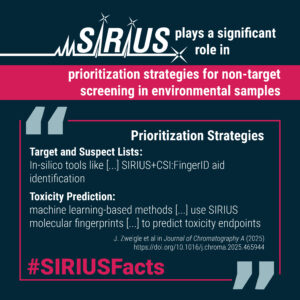
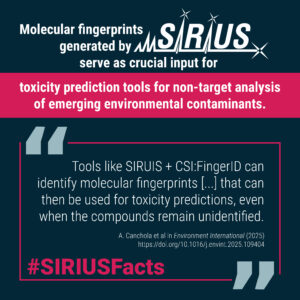
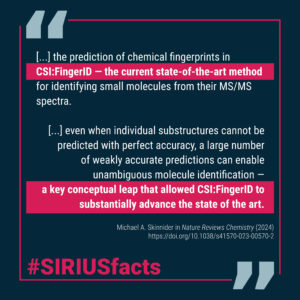
Voices from the community: What others say about SIRIUS
See what SIRIUS finds in your data
Millions of queries are processed every year in SIRIUS to characterize the compounds that spectral libraries can’t. Bring your fragmentation data and see what surfaces.

Related solutions
Forever chemicals in water, soil and consumer products
Impurities, E&Ls and Contaminant Screening
Extractables, leachables and degradation products
Metabolism and Biotransformations
Biotransformation routes across biological systems
Pharmaceuticals and Drug Discovery
Drug leads, metabolites and degradants
Explore more on the blog
Browse related discoveries and application notes by topic.
For Research Use Only. Not for use in diagnostic procedures.