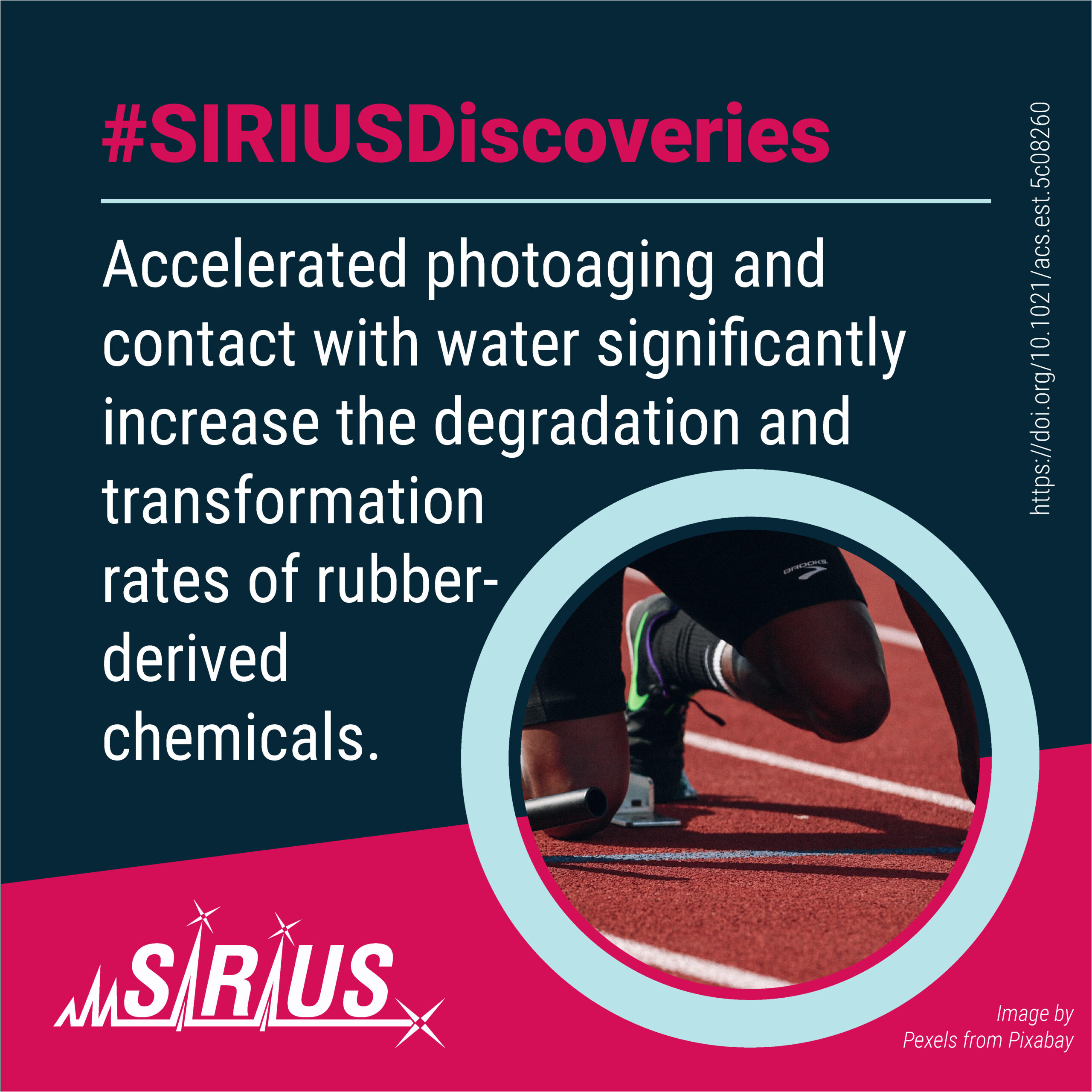
#SIRIUSDiscoveries
A new study reveals that the "aging" of rubber is far more chemically complex than previously thought. By exposing tire wear particles and turf crumb rubber to 12 weeks of natural and artificial weathering, researchers found that water and UV light significantly accelerate the release and transformation of additives.
💻 Structural elucidation through SIRIUS was essential in navigating the "dark matter" of environmental chemistry, allowing the team to annotate 45 transformation products never before reported.
💻 Structural elucidation through SIRIUS was essential in navigating the "dark matter" of environmental chemistry, allowing the team to annotate 45 transformation products never before reported.
#SIRIUSDiscoveries
Iron-rich minerals like hematite cover the Martian surface, but their stability makes iron difficult for life to access. Researchers are now uncovering how extremophilic life-forms might overcome this barrier, leaving "chemical fingerprints" behind for future rovers to find.
💻 To map these complex biological signatures, researchers employed SIRIUS to predict molecular formulas and chemical classes for unknown metabolites. They annotated 47 major metabolites, including rare siderophores and redox-active polyketides.
💻 To map these complex biological signatures, researchers employed SIRIUS to predict molecular formulas and chemical classes for unknown metabolites. They annotated 47 major metabolites, including rare siderophores and redox-active polyketides.
#SIRIUSDiscoveries
As Arctic glaciers melt at an accelerated rate, they release vast amounts of "foreign" organic matter into our oceans. But what exactly is in this water, and how does it change as it moves from ice to sea? The complexity of environmental dissolved organic matter (DOM) makes traditional identification nearly impossible.
Researchers utilized SIRIUS to predict compound classes directly from MS/MS fragmentation data. This allowed them to move beyond simple elemental ratios and identify specific shifts in lipids, benzenoids, and organic nitrogen compounds, providing a much clearer picture of the Arctic’s changing carbon cycle.
Researchers utilized SIRIUS to predict compound classes directly from MS/MS fragmentation data. This allowed them to move beyond simple elemental ratios and identify specific shifts in lipids, benzenoids, and organic nitrogen compounds, providing a much clearer picture of the Arctic’s changing carbon cycle.
#SIRIUSDiscoveries
Generating consistent data across metabolites, lipids, and proteins from a single biological sample is a major challenge in systems biology. Biological variability can often mask real insights when samples are processed separately.
Monophasic extraction with 400 nm beads and 60-minute on-bead protein digestion is the most reproducible, efficient, and cost-effective solution for in-house multiomics (metabolites, lipids, proteins) workflows in HepG2 cells.
Monophasic extraction with 400 nm beads and 60-minute on-bead protein digestion is the most reproducible, efficient, and cost-effective solution for in-house multiomics (metabolites, lipids, proteins) workflows in HepG2 cells.
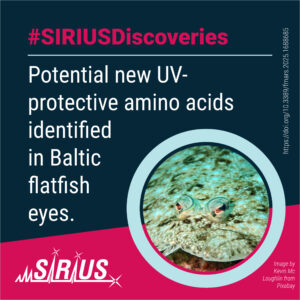
#SIRIUSDiscoveries
Marine organisms in shallow coastal waters face a constant challenge: harmful ultraviolet radiation (UVR). While it is known that fish accumulate sun-protective mycosporine-like amino acids (MAAs) from their diet, the internal distribution and diversity of these compounds have remained largely unexplored.
💻 Using SIRIUS 6 researchers shed light on how higher trophic level consumers adapt to solar stress through selective nutrient transport.
💻 Using SIRIUS 6 researchers shed light on how higher trophic level consumers adapt to solar stress through selective nutrient transport.
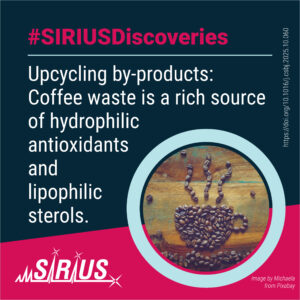
#SIRIUSDiscoveries
Every year, the coffee industry generates over 10 million tons of waste, much of which is improperly disposed of, leading to significant environmental impacts. However, these by-products—defective green beans and spent coffee grounds—are hidden reservoirs of bioactive compounds with vast potential for the nutraceutical and cosmetic industries.
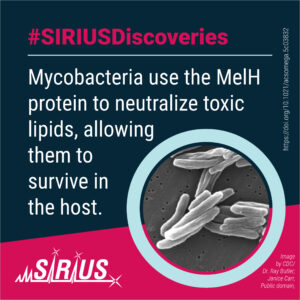
#SIRIUSDiscoveries
Understanding how Mycobacterium tuberculosis survives within the human host is critical for developing new treatments against one of the world's deadliest infectious agents. A recent study has provided new biochemical insights into how Mycobacterium tuberculosis and its close relative Mycobacterium marinum survive oxidative stress within host organisms.
SIRIUS played a key role in the annotation of the complex lipids.
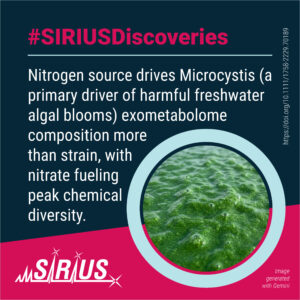
#SIRIUSDiscoveries
Harmful algal blooms pose significant economic and health risks to freshwater systems worldwide. A new study offers critical insights into the molecular factors driving the toxicity and succession of these blooms. To characterise the "chemical dark matter," the researchers employed SIRIUS to annotate molecular formulas and structures and predict chemical classes for the unannotated features.

#SIRIUSFeature
Powerful Integrations
SIRIUS’ powerful integrations with prominent third-party tools allow users to easily transition from raw data processing to advanced structural elucidation by automating data transfer and mapping identification results back into the host software’s native interface. These bridges enable users to maintain efficient, reproducible workflows without manual file conversions.
SIRIUS’ powerful integrations with prominent third-party tools allow users to easily transition from raw data processing to advanced structural elucidation by automating data transfer and mapping identification results back into the host software’s native interface. These bridges enable users to maintain efficient, reproducible workflows without manual file conversions.
#SIRIUSDiscoveries
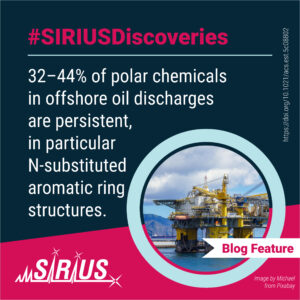
How many persistent chemicals are we discharging into the sea without knowing it?
A new study introduces "Persistence-Directed Testing," a novel approach to assessing complex industrial mixtures. By combining 60-day biodegradation tests with LC-HRMS and advanced computational tools, researchers investigated produced water from North Sea oil platforms.
A new study introduces "Persistence-Directed Testing," a novel approach to assessing complex industrial mixtures. By combining 60-day biodegradation tests with LC-HRMS and advanced computational tools, researchers investigated produced water from North Sea oil platforms.

#SIRIUSFeature
Visualizing Results
The SIRIUS graphical user interface offers several dedicated views to interpret results. Navigate systematic, organized views for every step of the process—formulas, compound classes, structures, and library matches—allowing for rapid, confident interpretation and reporting.
The SIRIUS graphical user interface offers several dedicated views to interpret results. Navigate systematic, organized views for every step of the process—formulas, compound classes, structures, and library matches—allowing for rapid, confident interpretation and reporting.

Analytica 2026
The largest gathering for laboratory technology and analysis is just days away, and we are geeting ready to meeting you in Munich! See SIRIUS 6 in action—from automated LC-MS/MS preprocessing to de novo structure generation of unknowns.
#SIRIUSDiscoveries
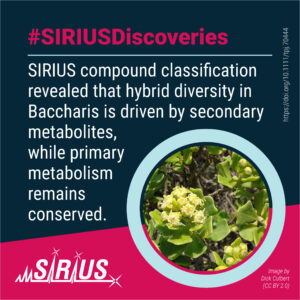
How does natural hybridization shape the chemical repertoire of plants? A new study provides deep insights into metabolic evolution, revealing that hybrid plants can achieve a "combinatorial" chemistry that exceeds the diversity of their parents.
To understand the drivers of chemical variation, the researchers used SIRIUS for systematic metabolite annotation and class prediction.
To understand the drivers of chemical variation, the researchers used SIRIUS for systematic metabolite annotation and class prediction.
#SIRIUSDiscoveries
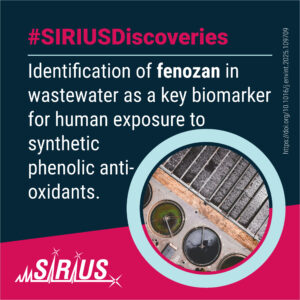
Synthetic antioxidants (SAOs) are ubiquitous additives found in plastics, food, and cosmetics. Yet, understanding how humans metabolize these compounds and tracking their presence in the environment remains a significant analytical challenge.
💻 Tools like SIRIUS are essential for translating complex spectral data into actionable chemical insights.
💻 Tools like SIRIUS are essential for translating complex spectral data into actionable chemical insights.

#SIRIUSFeature
Streamlined Workflows & Presets
SIRIUS integrates all necessary identification steps—from molecular formula annotation to compound structure and class prediction—into a single, coherent workflow. You can use expertly curated one-click computation presets for saving and reloading optimized, validated setups for common analysis scenarios.
SIRIUS integrates all necessary identification steps—from molecular formula annotation to compound structure and class prediction—into a single, coherent workflow. You can use expertly curated one-click computation presets for saving and reloading optimized, validated setups for common analysis scenarios.
#SIRIUSDiscoveries
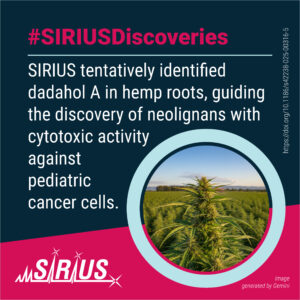
While industrial hemp is widely cultivated for fiber and cannabinoids found in its aerial parts, the roots are often overlooked and treated as agricultural waste.
💻 Using high-resolution mass spectrometry MSn data analyzed with SIRIUS, a research team successfully identified specific neolignans, including dadahol A and dadahol B, which exhibit significant cytotoxic effects on pediatric cancer cell lines.
💻 Using high-resolution mass spectrometry MSn data analyzed with SIRIUS, a research team successfully identified specific neolignans, including dadahol A and dadahol B, which exhibit significant cytotoxic effects on pediatric cancer cell lines.
#SIRIUSFeatures
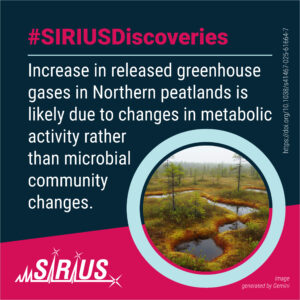
Peatlands are global "carbon banks," locking away half of Earth’s soil carbon. But as temperatures rise, we need to know: how do the microbes beneath the surface regulate greenhouse gas release?

#SIRIUSFeature
Powerful Suite of Interfaces
SIRIUS offers three interconnected interfaces—GUI, CLI, and API—that share a persistence layer, ensuring results from large-scale automated computations are always ready for manual, visual inspection.
SIRIUS offers three interconnected interfaces—GUI, CLI, and API—that share a persistence layer, ensuring results from large-scale automated computations are always ready for manual, visual inspection.
#SIRIUSFacts
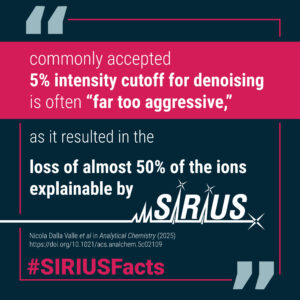
A critical look at how spectral denoising affects compound identification and molecular network reliability.
A study found that applying a standard 5% intensity cutoff was often too aggressive, resulting in the loss of nearly 50% of the ions explained by SIRIUS.
A study found that applying a standard 5% intensity cutoff was often too aggressive, resulting in the loss of nearly 50% of the ions explained by SIRIUS.
#SIRIUSDiscoveries
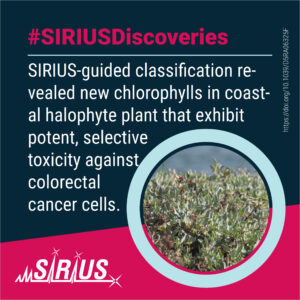
A new study demonstrates how computational mass spectrometry tools are accelerating the discovery of selective anticancer agents from unexplored natural sources. The researcher team successfully utilized SIRIUS for metabolite annotation and compound classification to prioritize for targeted purification, which led to the isolation of eight previously undescribed metabolites.