Diterpenoid alkaloids are an exceptionally complex class of plant metabolites heavily valued for their therapeutic potential. However, their intricate architectures render chemical synthesis unfeasible, while their trace abundance in wild plants, like wolfsbane, limits pharmaceutical scaling. Biosynthetic production in heterologous hosts offers an appealing alternative, but the specific enzymatic steps assembling these compounds have remained uncharacterized.
In a recent study published in Molecular Plant, researchers deployed a combination of comparative transcriptomics and advanced computational metabolomics to solve the entry steps of diterpenoid alkaloid biosynthesis. The team utilized SIRIUS within their untargeted LC-MS/MS pipeline to systematically annotate molecular formulas and predict compound classes to unlock the nitrogen-tracking pathway.
Key discoveries:
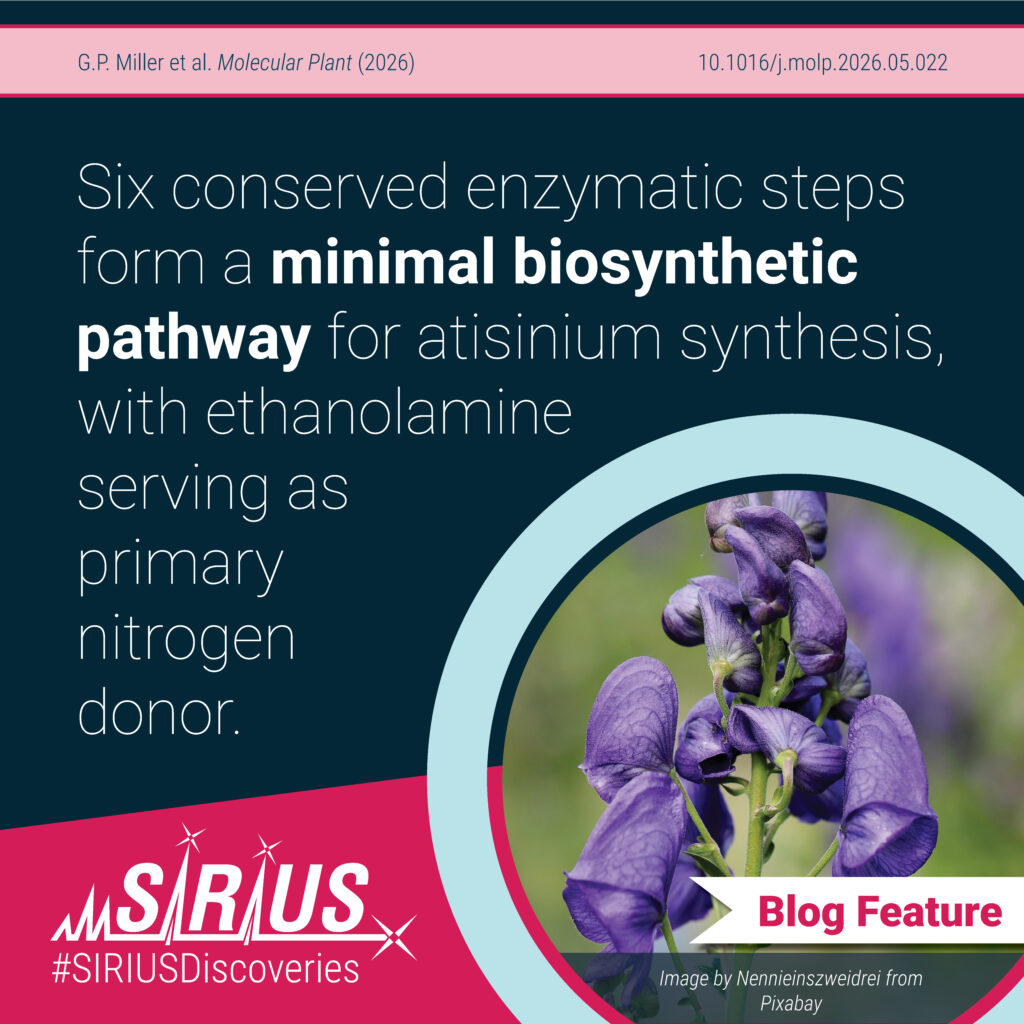
✨ Ethanolamine, rather than ethylamine, serves as the primary nitrogen donor for this class of metabolites—even when the final structures prominently display an ethyl group.
✨ Elucidation of six conserved enzymatic steps that form a minimal biosynthetic pathway sufficient for the de novo production of the foundational diterpenoid alkaloid atisinium.
G.P. Miller et al. Molecular Plant (2026) 10.1016/j.molp.2026.05.022