Cultural heritage of textile dyeing
Ancient textiles, such as clothes, tapestries, and carpets, offer a window into the technological and social history of past civilizations. Before synthetic dyes emerged in the mid-19th century, craftsmen relied on a vast array of botanical sources to produce colors. Among these, yellow is particularly complex to trace because it can be derived from the greatest diversity of species—from weld and pomegranate to saffron1. Identifying the botanical origin of natural dyes is essential for understanding the historical, geographical, and chemical context of cultural heritage objects.
Identifying the botanical origin holds valuable information for chemists, historians, conservators and restorers1
Determining the exact raw materials used to craft an object helps to determine when and where an object was created. The choice of dye often reflects the social standing of the object’s owner, as certain rare or imported dyes were reserved for the elite. Also, botanical identification allows scientists to accurately reconstruct ancestral recipes and traditional dyeing techniques. Detecting plants not native to a finding site suggests potential exchanges of knowledge or materials For conservators, identifying the plant source is a technical necessity, as many yellow molecules, such as phloroglucinol derivatives, are unstable and degrade when exposed to light and oxygen.
The Challenge of Botanical Provenance
The primary obstacle in identifying the plant source of yellow dyes lies in the chemical overlap between species. Many yellow dye plants contain the same major flavonoids, such as quercetin, luteolin, or kaempferol1. Because these compounds are ubiquitous, their presence alone cannot definitively pinpoint a specific botanical origin. To move beyond these non-specific markers, researchers must identify “taxonomic chemical markers”—compounds unique to certain plants—that remain detectable even after centuries of degradation.
Finding “Gold” markers
Researchers at Avignon University address this gap by applying an LC-MS-based metabolomics approach to compare common yellow dye plant species and isolate robust, species-specific markers2. They selected a panel of 14 plants based on their documented ancestral use as yellow dyes, spanning various botanical families and plant parts (e.g., heartwood, berries, and flowers). The dried plant materials underwent ultrasound-assisted extraction and analysis via UPLC-HRMS/MS in both positive and negative electrospray ionization (ESI) modes to capture a wide range of chemical families.
The researchers established a “Gold, Silver, Bronze” ranking system for chemical markers, with “Gold” markers representing the most robust compounds. A “Gold” marker has a very high specificity, i.e. it is almost exclusively found in that single plant and is practically absent in the others.
Molecular Annotation with SIRIUS
Annotating the vast number of detected metabolites is a significant bottleneck in untargeted metabolomics. While molecular networking through the GNPS platform allowed the team to visualize structural similarities and match known spectra to libraries, many specific markers remained unidentified. The researchers utilized SIRIUS to resolve these unknowns. When markers yielded no match in spectral libraries, the team imported MS/MS data into SIRIUS to perform in silico analysis. The software facilitated the study by proposing de novo molecular formulas for unknown features and putatively annotating molecular structures.
Discoveries and Novel Markers
The integration of SIRIUS and molecular networking led to the identification of several key taxonomic markers that provide higher resolution than traditional dye analysis.
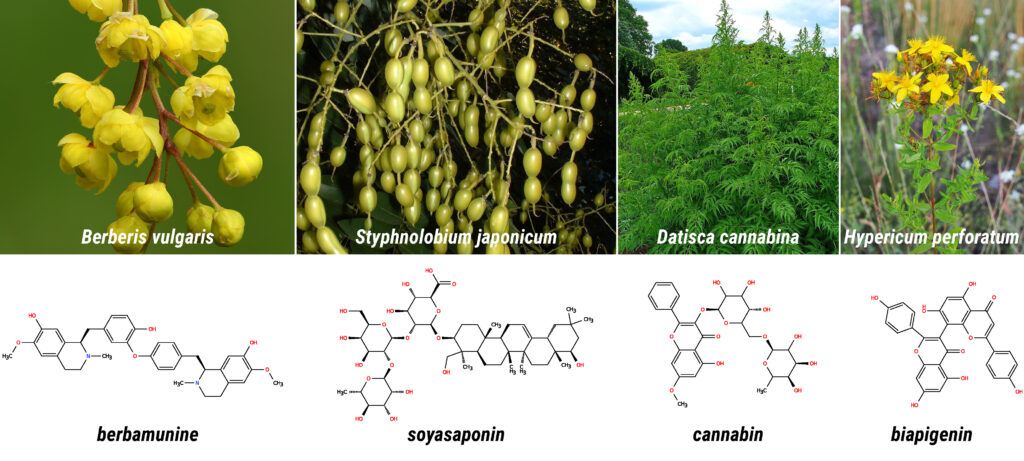
- Berberis vulgaris: Beyond the well-known alkaloid berberine, the study identified berbamunine as a specific marker for this species.
- Styphnolobium japonicum: The study highlighted five triterpene saponins (e.g. soyasaponin) as more specific “Gold” markers than those used until now (e.g. quercetin, kaempferol, rutin).
- Datisca cannabina: The software helped annotate glycosylated flavonols like cannabin and datinoside as robust indicators for this species.
- Hypericum perforatum: The study highlighted biapigenin and a hyperforin derivative as key markers, noting that while quercetin is often used to identify this plant, it lacks the necessary specificity.
Impact on Cultural Heritage Science
This study demonstrates that metabolomics, supported by in silico tools like SIRIUS, is an essential approach for cultural heritage chemistry. By shifting the focus from the most abundant pigments to the most discriminating metabolites, scientists can accurately reconstruct traditional dyeing recipes and the geographical origins of historical objects. The capability to putatively annotate chemical structures allows researchers to build a database of “Gold” markers, which can eventually be used in targeted LC-MS analyses of micro-samples taken directly from ancient textiles.
References
- S. Abu-Ghosh, N. Sukenik, Z. Amar, D. Iluz. Yellow dyes in archaeological textiles: sources, locations, identification, and challenges. J. Archaeol. Sci. Rep. (2023) https://doi.org/10.1016/j.jasrep.2023.104030 ↩︎
- L. Mas-Normand, O. Dangles, C. Mathe, G. Culioli. Identification of yellow dye plant chemical markers for applications in cultural heritage using LC-MS-based metabolomics and molecular networking. Microchem. J. (2025) https://doi.org/10.1016/j.microc.2025.115621 ↩︎