Phenolic natural products are a diverse group of specialized metabolites found throughout the plant kingdom. These compounds are essential to a plant’s survival and are responsible for many of the health benefits humans get from eating plants or using them as medicine. Ferns represent a significant gap in our understanding of phenolic specialized metabolism.
Mapping the Phenolic Landscape of Blechnaceae
Researchers at the Philipps-Universität Marburg aimed to resolve this by analyzing 32 fern species across all three subfamilies of Blechnaceae1. The study focused on identifying and quantifying caffeoyl-5-O-quinic acid (5-CQA), rosmarinic acid, and related caffeic acid derivatives. By combining LC/ESI-MS/MS, HPLC, and NMR, the team sought to understand the distribution of these metabolites and their biosynthetic origins.
The Blechnaceae are a diverse family of ferns found mostly in tropical regions and Australia2. They are divided into three main groups (Blechnoideae, Stenochlaenoideae, and Woodwardioideae) and include over 200 species. These ferns are chemically distinguished by a high abundance of specialized metabolites, such as flavonoids and polyphenols, which underpin their extensive use in traditional Chinese, Indian, and Chilean medicine for treating skin, bladder, and gastrointestinal disorders3.
Identifying the Unknown with SIRIUS and CSI:FingerID
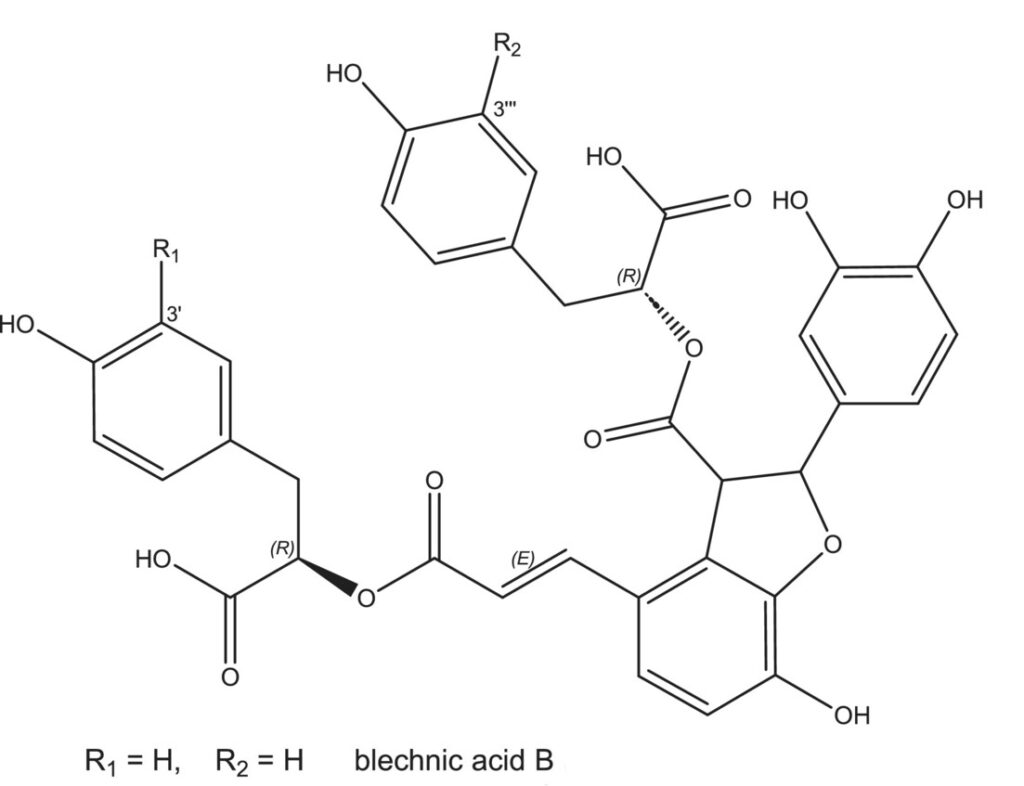
During the analysis of Neoblechnum brasiliense, the researchers encountered a prominent, unknown peak in the HPLC chromatograms. To elucidate the structure of this molecule, they leveraged the power of SIRIUS molecular structure annotation. LC/ESI-MS/MS data for the unknown compound (m/z [M-H]– 685.1525) was imported and SIRIUS identified a crucial structural fragment: a blechnic acid moiety. This computational insight allowed the researchers to target their search, eventually identifying the compound as a novel lignan named blechnic acid B.
Blechnic acid is a specific type of lignan formed from the coupling of two caffeic acid molecules4. It is considered a characteristic compound of ferns in the Blechnaceae family. This study identified a new version called blechnic acid B, which is a dimer of isorinic acid (caffeoyl-4′-hydroxyphenyllactic acid) rather than pure caffeic acid.
Discoveries in the Fern “Tree of Life”
The study successfully identified blechnic acid B (BAB), a dimer of isorinic acid (caffeoyl-4′-hydroxyphenyllactic acid) previously unknown in ferns. Moreover, they tentatively identified three additional related lignans in N. brasiliense that possess varying numbers of dihydroxyphenyllactic acid moieties. The analysis revealed that while 5-CQA is ubiquitous across the Blechnaceae, rosmarinic acid and blechnic acid B are highly restricted, appearing only in specific genera within “superclade B” of the Blechnoideae subfamily.
Why Computational Annotation Matters
This paper highlights the critical role of advanced in-silico tools like SIRIUS in natural product discovery. Elucidating the structure of unknown metabolites—the “dark matter” of the metabolome—is often a manual and time-consuming process. By rapidly predicting core structural moieties from fragmentation data, SIRIUS provides a scalable solution to unlock the chemical secrets of under-studied organisms, bridging the gap between mass spectrometry and biological understanding.
References
- M. Ufland and M. Petersen. Phenolic compounds in species of the Blechnaceae. Plant Biol. (Stuttg.) (2026) https://doi.org/10.1111/plb.70116 ↩︎
- A.L. de Gasper, T.E. Almeida, V.A.O. Dittrich, A.R. Smith, and A. Salino. Molecular phylogeny of the fern family Blechnaceae (Polypodiales) with a revised genus-level treatment. Cladistics (2017) https://doi.org/10.1111/cla.12173 ↩︎
- E.N. Waswa, F.W. Muema, W.O. Odago, E.S. Mutinda, C. Nanjala, E.M. Mkala, S.G. Amenu, S.X. Ding, J. Li, and G.W. Hu. Traditional Uses, Phytochemistry, and Pharmacological Properties of the Genus Blechnum-A Narrative Review. Pharmaceuticals (Basel) (2022) https://doi.org/10.3390/ph15070905 ↩︎
- H. Wada, T. Kido, N. Tanaka, T. Murakami, Y. Saiki, and C.M. Chen. Chemical and Chemotaxonomical studies of ferns. LXXXI. Characteristic lignans of Blechnaceous ferns. Chem. Pharm. Bull. (1992) https://doi.org/10.1248/cpb.40.2099 ↩︎